Hackathon
The goal of the Hackathon is to climb small walls using humanoid-shaped robots.
The three challenges below can be tackled independently — teams are free to focus on any single challenge or combine several of them.
Challenge 1 — Perception
Build a 3D model of the climbing wall and estimate the robot's pose in real time. Can be addressed independently of planning and control.
Challenge 2 — Planning
Generate a feasible path and contact sequence for climbing the wall. Fiducial markers can be used so perception is not required.
Challenge 3 — Control
Whole-body execution of the planned motion on a physical robot platform. A pre-computed contact plan can be provided so planning is not required.
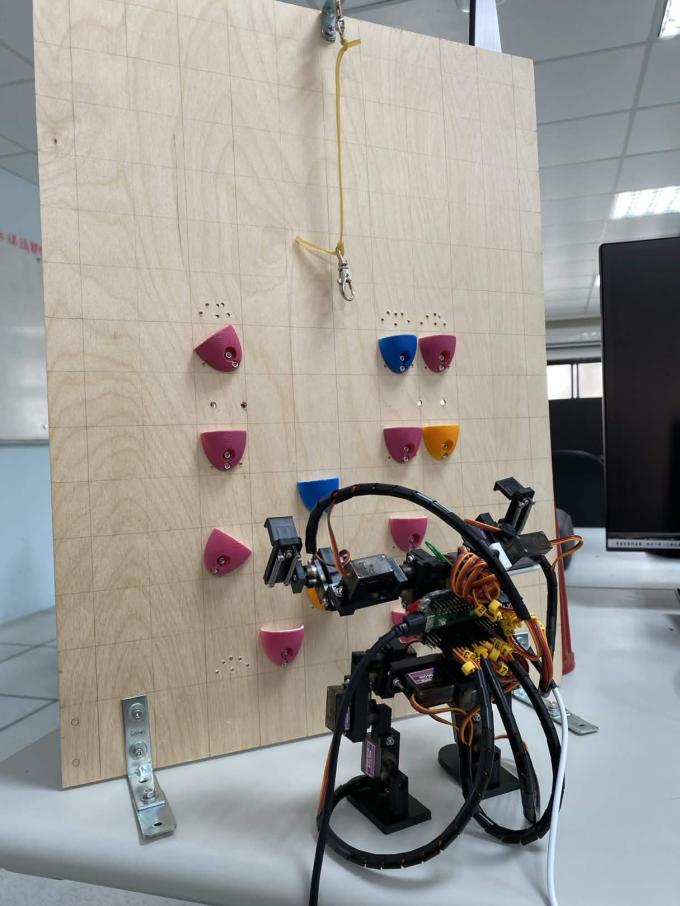
Climbing robot prototype developed by the organizers.
Practical Information
- A simulator will be released by the organizers (date T.B.D.)
- A small-size robotic platform will be provided
- Fiducial markers available — teams can skip perception and focus on planning & control
- Official rules released: read the rules (PDF) v1.1 · release history
Hardware specifications
Microban will be used as a base to design a climber for the Hackathon.
Specifications for the small climbing wall and the robotic platforms are still being designed — they will be published here as soon as they are finalized.
Rhoban/microban on GitHub Taiwan
 Germany
 France
 Scotland